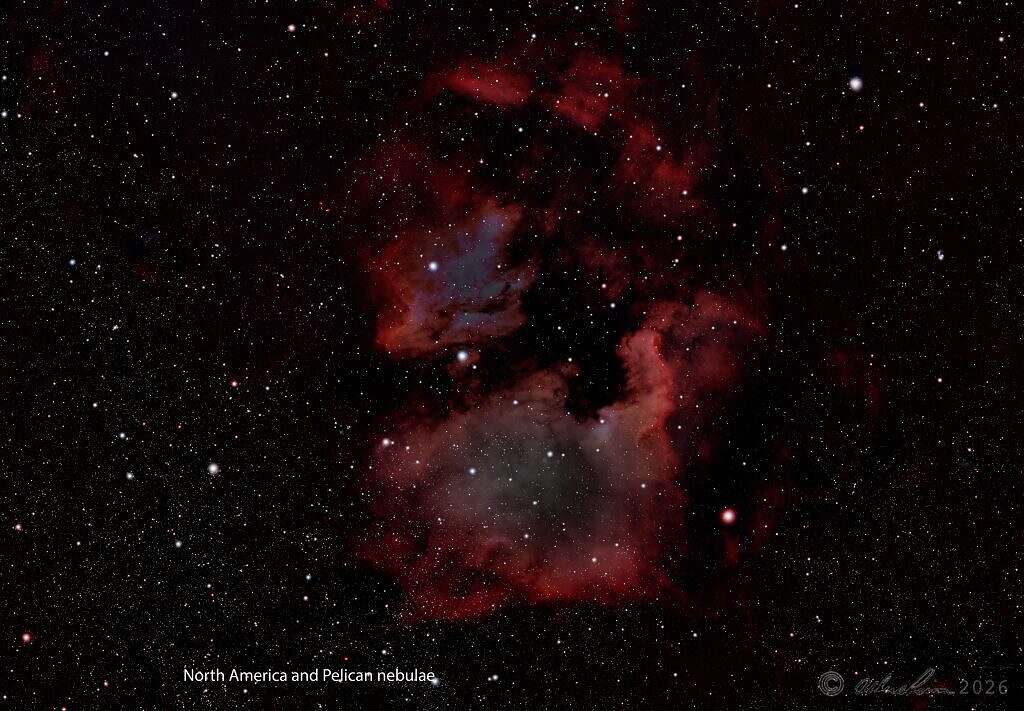
This wide field view, taken with a 243mm lens and a DSLR camera with full-frame sensor, contains the North America nebula (NGC 7000) and the Pelican nebula (IC 5070), displayed in an HOO color palette.
Distances and sizes:
The North America nebula is 2590 light-years (15.228 quadrillion miles) from earth and spans 140×90 light-years (823×529 trillion miles). The Pelican nebula is 1800 light-years (10.6 quadrillion miles) from earth.
Imaging and Processing:
Due to the time of year, these objects were only imageable for just over 5 hours, having to wait until midnight for the nebula to rise up high enough. I captured 60 images of 5 minutes each, but only 54 images of these were useable. I calibrated these with 30 biases, 30 darks, 30 flats, and 30 dark flats. I used SPCC for color correction, DynamicCrop to remove the vignetting caused from using the step-down rings for the 2” L-Enhance filter. I used Graxpert to remove gradients, noise and blur exterminators to remove noise and sharpen the stars and nebula. I then separated the stars from the nebulous background and used Narrowband Normalization with masking and curves to emphasize the reds (hydrogen) and blues (oxygen). I recombined the stars, then finished off the image in Photoshop.
Equipment:
• Lens: SV555 243mm APO Astrograph at f/4.5
• Camera: Canon RP DSLR with full-size sensor
• Mount: SkyWatcher Star Adventurer GTi
• Filter: Optolong L-Enhance, using step-down rings, under Bortle-6 skies with full moon
• Guiding: ZWO ASI120mm Mini Monochrome Guide Camera with the ZWO 30mm f/4 Guide Scope
• Automation: ZWO ASIAir Mini