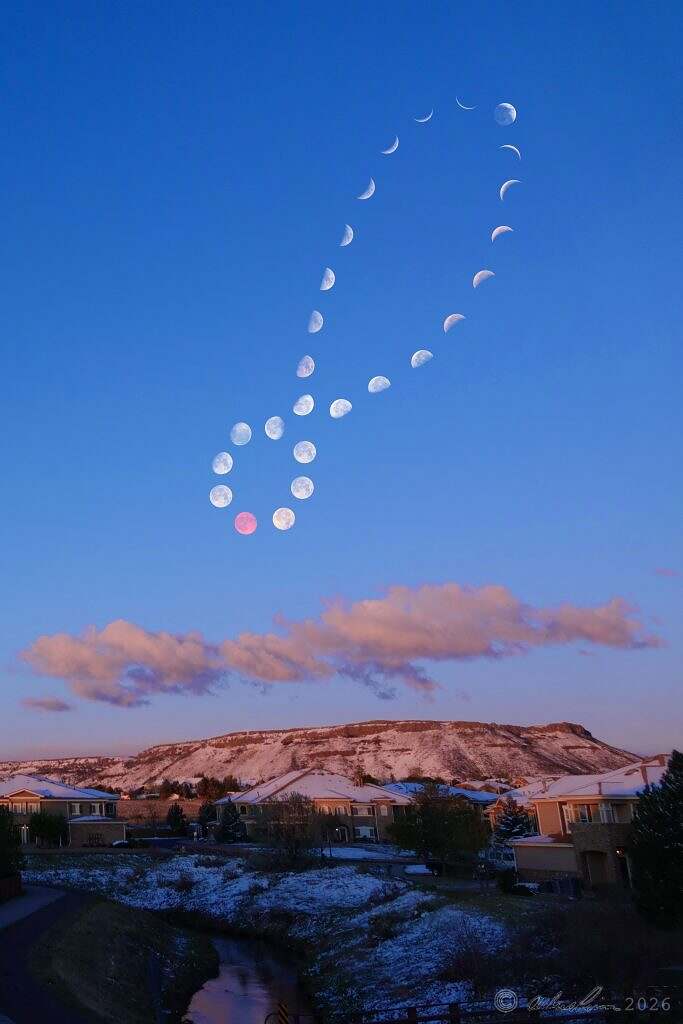
Definition and Information
In astronomy, an analemma is a diagram or figure-eight-shaped curve that shows the position of a celestial object such as the Sun or Moon, in the sky, as seen from a fixed location on Earth, at the same clock time throughout the course of an object’s complete cycle, a year for the Sun or 28 days for the Moon.
The figure-eight shape is created by two combined astronomical realities:
- North-to-South Movement: The up-and-down length of the figure eight is caused by the tilt of Earth’s axis (about 23.5°) relative to its orbit, which makes the Sun appear higher in the summer and lower in the winter.
- East-to-West Movement: The wider and narrower loops of the figure eight are caused by the elliptical (oval-shaped) orbit of Earth. Because Earth travels at slightly different speeds depending on how close it is to the Sun, solar time and clock time fall out of sync throughout the year (a phenomenon known as the Equation of Time)
Technical
An analemma can be photographed by keeping a camera at a fixed location and orientation and taking multiple exposures throughout the month or year, always at the same time of day (disregarding daylight savings time and with as little cloud cover as possible).
A lunar analemma as depicted above, can be observed when you take a photo of the moon at the same time every day for a month. However, imaging an analemma of the Moon requires a bit of patience, persistence and luck. On average, the Moon returns to the same position in the sky about 50 minutes and 29 seconds later each day. So, to photograph the lunar analemma, you need to take pictures of the moon every 24 hours, 50 minutes and 29 seconds later each day, being careful not to move the camera/tripod combination throughout that month, and hoping clouds don’t get in the way. Over a lunar month, the Moon will trace an analemma-like curve as its actual position wanders due to its tilted and elliptical orbit.
Imaging
This composite image took 2 months to capture, in April and June 2026. The first attempt was my learning experience, and I missed many shots due to clouds. My second attempt, in June, was much more successful, but still had challenges, such as the last moon image, taken on June 30. That image, at the bottom of this curve, was affected by the smoke from the Aspen Acres fire. By coincidence, this moon was the second full moon of the month of June, and is called a strawberry moon.
This final image is a composite of 25 close-up shots, layered on top of the positional, wide-angle shots (the moon appears very small in the wide-angle, 24mm shots) with a single background image. I used Photoshop as my layering software. The single background image was take at sunset shortly after one of the last snows of the year in April. Each close-up shot was selected from a group of 9-18 bracketed shots taken at night for greatest contrast and focus, taken at 600mm. The top image in this shot takes the place of the new moon and is a blended shot of the dark half, with the light half. The positional shots were single images taken at the exact time, precisely 24 hours, 50 minutes, and 29 seconds after the previous shot, and taken at 24mm, at ISO 100 or 200 at f/4.
Equipment
I used a Sony RX10 M4 camera with its built-in 24-600mm zoom lens. Most of the close-ups had a variety of shutter speeds from 1/5th to 1/1000th of a second. I used a remote shutter release and sturdy Manfrotto tripod, which I tried not to move through those 2-3 months.